
Refresh Your Office (And Your Employees Will Thank You for It)


May 21, 2026
Refresh Your Office (And Your Employees Will Thank You for It)
When a workspace starts to feel stagnant, the immediate instinct is often to look for the exit. We assume that low office attendance, siloed teams, or a lack of energy means we have simply outgrown the building. But before you start touring new real estate, take a closer look at the space you already have.
More often than not, the problem isn’t the address—it’s the blueprint.
You don’t necessarily need a new building to breathe life back into your company culture. By intelligently reconfiguring your current floor plan, introducing flexible furniture, and creating dedicated zones for interaction, you can completely transform the employee experience. A strategic refresh can make a world of difference, saving significant capital while delivering a workplace your teams actually want to commute to.
Break the Grid: Reconfiguring the Floor Plan
For decades, the standard office layout was a rigid grid: rows of assigned desks flanked by a few formal meeting rooms. This layout optimizes for density, not human behavior.
A successful refresh starts by breaking that grid. Instead of dedicating 80% of your floorplate to static, individual workstations, redistribute that space to reflect how work actually happens today.
Create Neighborhoods: Group teams into smaller "neighborhoods" that blend a few dedicated desks with adjacent, team-specific huddle spaces. This provides a sense of home base without chaining people to a single monitor.
Open Up the Bottlenecks: Identify areas where flow is restricted or natural light is blocked. Tearing down a few non-load-bearing walls or replacing opaque partitions with glass can instantly make an older floor plan feel expansive and modern.
The Power of the Lounge
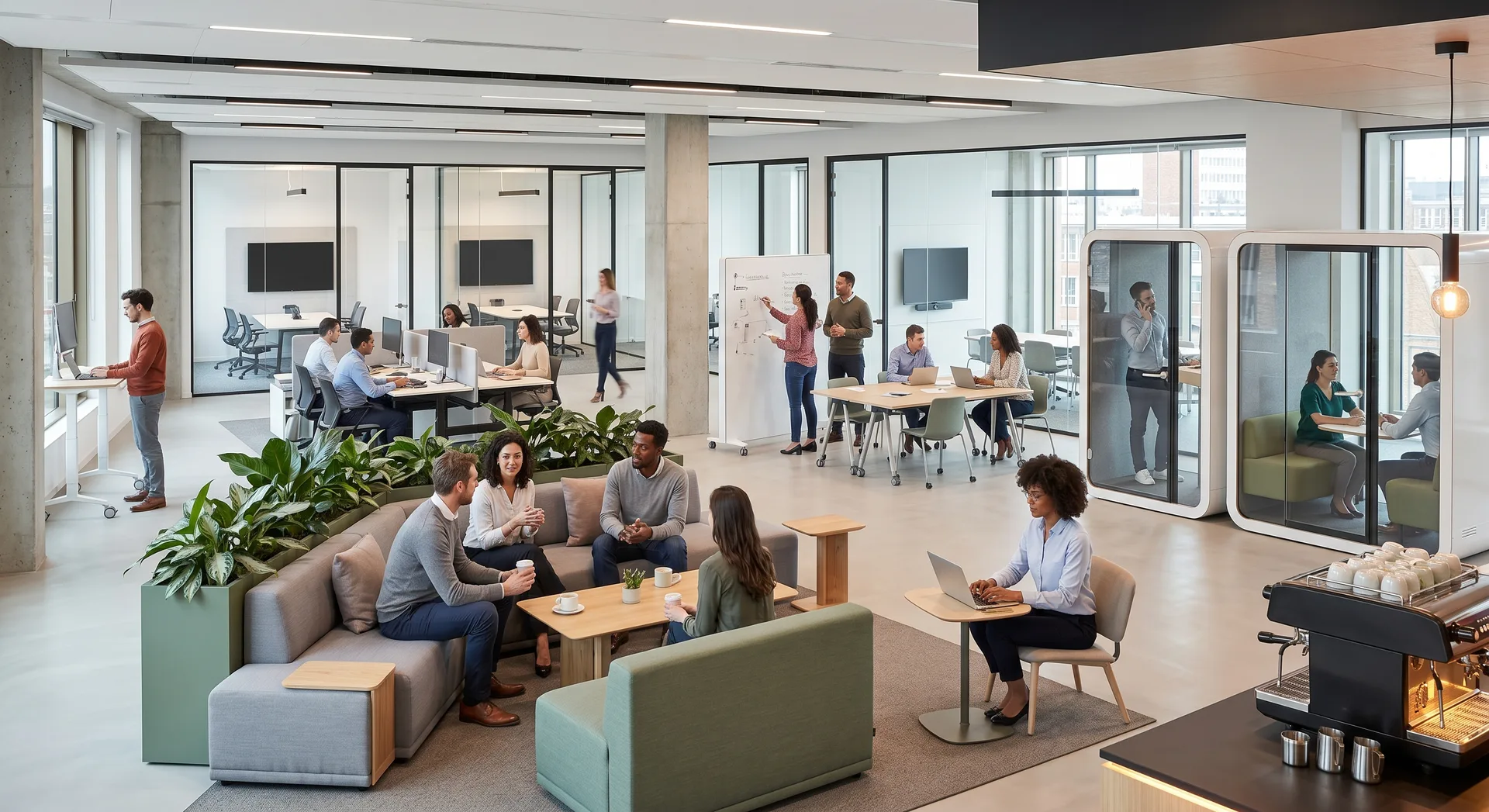
If you want people to collaborate, you have to build spaces where they naturally want to gather. The corporate cafeteria or the cramped kitchenette of the past is being replaced by the Work Café or Social Lounge.
Adding a central lounge area does more than provide a place to eat lunch. It acts as the cultural heartbeat of the office. When you design a space with comfortable seating, good acoustics, and excellent coffee, you create the conditions for "casual collisions"—those unplanned conversations between departments that spark new ideas and solve problems faster than an email thread.
A well-designed lounge signals to employees that their comfort and social connections are valued, instantly boosting morale.
Flexibility Through Furniture
You don’t need to pour concrete or move HVAC systems to change how a room functions. Today, the most impactful office transformations are achieved through furniture.
By swapping heavy, static boardroom tables for agile alternatives, a single room can serve three different purposes in one day.
Modular Seating: Sofas and ottomans that can be pulled apart for individual focus or pushed together for a team town hall.
Mobile Architecture: Whiteboards on casters, acoustic room dividers, and rolling standing desks allow teams to literally "hack" their space on the fly to suit a specific project.
Acoustic Pods: If you need more meeting rooms but can't build them, freestanding, soundproof phone booths and 4-person meeting pods can be dropped onto the floor plan in an afternoon.
The ROI of a Refresh
Moving to a new headquarters is a massive undertaking, requiring years of planning, massive capital expenditure, and significant operational disruption. A strategic refresh, on the other hand, can often be executed in phases while the business continues to run.
The return on investment is immediate. By investing in the space you already have—transforming it from a place where people have to work into a place where they want to interact—you improve retention, boost collaborative productivity, and send a clear message to your employees: we are investing in how you work today.